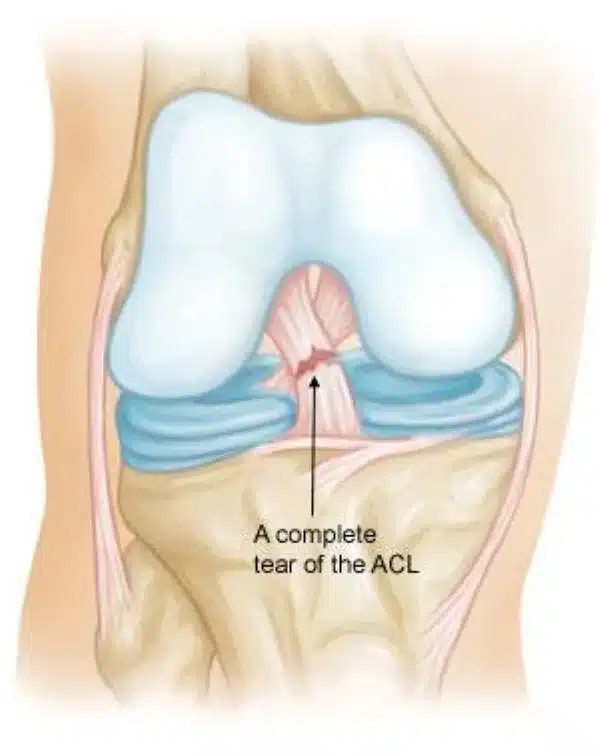

You may have been told that if you rupture your ACL in your knee, it cannot heal and surgery is the only option.
Would you believe me if I told you that this may not always be the case?
I have compiled a list of a lot of compelling evidence that shows a fully ruptured ACL definitely can heal on its own, and furthermore can show similar functional results as ACL surgery in many instances.
Your body might just be a lot more resilient than you may realize.
Here I have compiled a list of 7 research articles and my brief summaries of them. It is VERY compelling data.
| Authors: Filbay et al 2022 Title: Evidence of ACL Healing on MRI following ACL rupture treated with rehabilitation alone may be associated with better patient-reported outcomes: a secondary analysis from the KANON trial Link: https://pubmed.ncbi.nlm.nih.gov/36328403/ Summary: MRI appearance of ACL healing after ACL rupture occurred in one in three adults randomised to initial rehabilitation and one in two who did not cross-over to delayed ACLR and was associated with favourable outcomes. |
| Authors: Filbay et al 2023 Title: Healing of acute anterior cruciate ligament rupture on MRI and outcomes following non-surgical management with the Cross Bracing Protocol Link: https://pubmed.ncbi.nlm.nih.gov/37316199/ Summary: After management of acute ACL rupture with the CBP (Cross Bracing Protocol) , 90% (of 80) patients had evidence of healing on 3-month MRI (continuity of the ACL) |
| Authors: Ihara & Kawano 2017 Title: Influence of Age on Healing Capacity of Acute Tears of the Anterior Cruciate Ligament Based on Magnetic Resonance Imaging Assessment Link: https://pubmed.ncbi.nlm.nih.gov/28045756/ Summary: ~62% of 102 subjects showed healing of ACL 6 months post rupture without surgery, and with conservative management including bracing and rehab. |
| Authors: Costa-Paz et al 2012 Title: Spontaneous healing in complete ACL ruptures: a clinical and MRI study Link: https://pubmed.ncbi.nlm.nih.gov/21643922/ Summary: 14 out of 14 (100%) of subjects showed ACL healing at 2 year follow up and returned to their prior activity level. |
| Author: Frobel et al 2010 Title: A Randomized Trial of Treatment for Acute Anterior Cruciate Ligament Tears Link: https://www.nejm.org/doi/full/10.1056/NEJMoa0907797 Summary: 36 out of 59 subjects who did rehab only did not opt for surgery. |
| Author: Previ 2023 Title: Spontaneous healing of a ruptured anterior cruciate ligament: a case series and literature review Link: https://pubmed.ncbi.nlm.nih.gov/36738386/ Summary: The magnetic resonance imaging study at 6 months revealed an end-to-end continuous anterior cruciate ligament with homogeneous signal |
| Author: Fujimoto 2002 Title: Spontaneous healing of acute anterior cruciate ligament (ACL) injuries – conservative treatment using an extension block soft brace without anterior stabilization Link: https://pubmed.ncbi.nlm.nih.gov/12029510/ Summary: MRI confirmed that 21 injured ACL out of 23 knees showed ACL healing after using extension block soft brace for 2-3 month. 74% were shown to be stable at 16 month follow up. And 26% went to get ACl surgery due to instability. |
If you have torn your ACL, surgery is NOT your only option.
Reach out if you want to learn more. Schedule your free Discovery Call here.